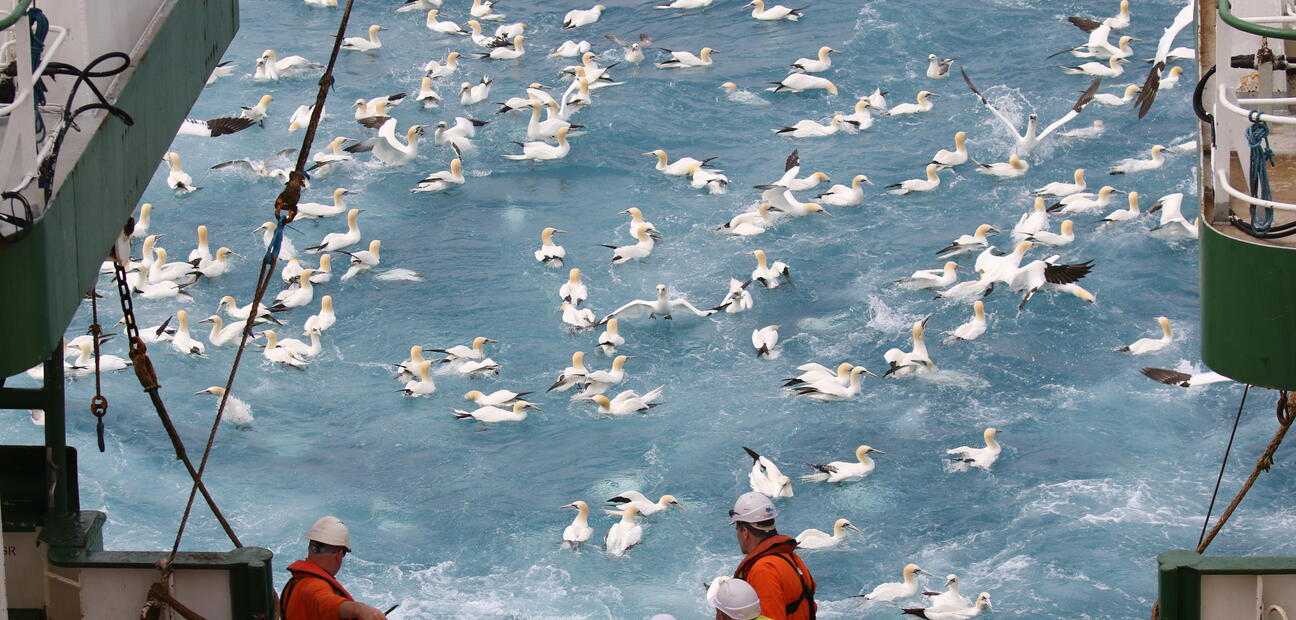
This project is a continuation of the previous Ecosystems Observers Scheme, funded under the EMFF support for MSFD and Biodiversity. Under this scheme, observers are placed on existing fisheries surveys to collect ecosystems information that would not otherwise be available. While this began in an ad-hoc way in 2010, since 2018 it has been standardized and formally funded. Data are shared with the National Parks and Wildlife Service.
The project is to place Marine Mammal and Seabird Observers on board certain Marine Institute surveys. These surveys have been previously selected by the Marine Institute and the National Parks and Wildlife Service as being the most suitable sampling design to act as platforms for the collection of additional ecosystems data. The work is designed to collect offshore information on populations of Marine Mammals, Seabirds, and other marine species, required under the Habitats Directive. The appropriate surveys are the Celtic Sea Herring Acoustic Survey, WESPAS Acoustic Survey and the Blue Whiting Survey, and the triennial Mackerel egg survey. They provide observation platforms and collect additional oceanographic, fisheries and biological data that can be combined to provide ecosystems information, rather than simply being fisheries surveys.
Data will be shared with the National Parks and Wildlife Service on a per-survey basis, and with other relevant state bodies on request. This project is essential to the delivery of advice and services for fisheries and Natura, under the PAF and Priority Area 1 of the EMFAF Biodiversity / Fisheries impacts programme.
The data collected under this programme will also enhance the use of the acoustic surveys. The collection of top-level predator data, as well as the existing fisheries data collected, and other oceanographic and planktonic data that is now routinely collected, allows each survey to move from single-stock assessment, to a multi-disciplinary survey. This allows trophic interactions, food webs and changes to populations caused by climate change or other interactions to be routinely recorded and monitored. Absence of data collection for the higher trophic levels would limit the work that can be done in this area.
The project will meet Ireland’s data reporting requirements under the Habitats directive for seabirds and Marine Mammals. Specifically, the data collected will provide necessary information for:
- Validated data available to stakeholders for use in MSFD, MPA and other national considerations.
- A long term time-series of marine mammal, seabird and other marine fauna sightings and effort data that can contribute to national and international datasets on population, structure and habitat use. In particular, offshore data that cannot otherwise be surveyed, will be collected and validated.
- To allow oceanographic and information from the complete ecosystem to be analysed, not just a single-stock assessment. Information will be available from planktonic to top-predator level.
- Long-term funding of this project will potentially allow changes in populations to be monitored, a metric required under climate change.
For the outputs measured below, each will be submitted individually for marine mammal sightings and for seabird sightings.
- A preliminary report submitted to the MI at the end of each survey, summarising all sightings, for use in the survey report. Data from this will be included in the survey report that is made available through the OAR system
- A complete report submitted six weeks after each survey end. This will include a full analysis (count, location, identification) of effort and sightings.
- A data package complying with NPWS data-reporting templates and standards. This will include all sightings raw data, observer effort data, data analysis and shape-files mapping the appropriate data.
- A package containing all photographs taken during each survey for identification validation purposes.