
EMFAF Overview
The EMFAF (European Maritime, Aquaculture and Fisheries Fund) runs from 2021 to 2027 and supports the EU common fisheries policy (CFP), the EU maritime policy and the EU agenda for international ocean governance.
EMFAF provides support for developing innovative projects ensuring that aquatic and maritime resources are used sustainably.
Which leads to:
- food security through the supply of seafood products
- growth of a sustainable blue economy
- healthy, safe and sustainably managed seas and oceans
As a global ocean actor and a major producer of seafood, the EU has a responsibility to protect and sustainably use the oceans and their resources. It is also in the EU's socio-economic interest to guarantee the availability of food supplies, the competitiveness of the maritime economy and the livelihood of coastal communities.
It helps achieve the UN’s Sustainable Development Goal 14 (‘conserve and sustainably use the oceans, seas and marine resources’), to which the EU is committed. Furthermore, the EMFAF helps fulfil the objectives of the European Green Deal, the roadmap for the EU climate and environmental policies.
MI EMFAF Overview
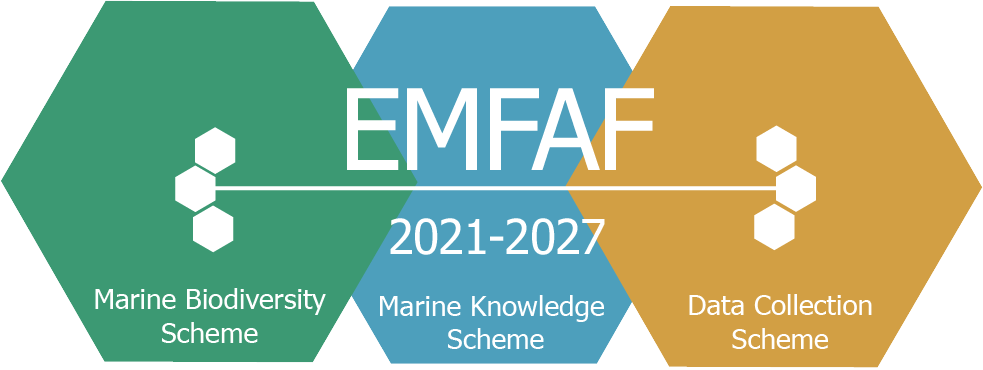
The Marine Institute is a key implementing body and beneficiary selected by the Irish EMFAF managing Authority. The marine Institute plays a crucial role in using EMFAF funding to implement three major schemes aimed at sustainable fisheries, marine biodiversity, and ocean governance.
- Marine Biodiversity Scheme: Supporting the monitoring of fishing and aquaculture impacts on marine environments, including Natura 2000 sites, Marine Protected Areas (MPAs), and MSFD obligations.
- Marine Knowledge Scheme: Improve the collection, management, and use of marine data, enabling evidence-based decision-making for sustainable blue economies and climate studies.
- Data Collection Scheme (DCMAP): National coordinating agency for the EU Data Collection Framework (DCF). This involves managing fisheries data such as research vessel surveys, port sampling of landings, and sea sampling of discards to support the Common Fisheries Policy (CFP).
The collection and use of biological, ecological and socioeconomic data is maximised by integrating across the three schemes, adding value to existing sampling programmes and developing multiple data products for different end-user and policy needs.
Operations of Strategic Importance
These are special projects selected by Member States and Managing Authorities because of their high strategic impact, strong visibility potential, and importance in telling the “story” of EU investment. Within the Marine Institutes EMFAF Schemes certain large, high‑impact, strategic projects clearly meet the OSI criteria because they contribute significantly to EMFAF priorities and are central to marine governance and sustainability objectives.